A forthcoming manuscript · AdeTunji O.
Altaghyir
What if humanity
had never been alone?
Three peoples. One Earth. Centuries of memory, power, and belonging. Enter a world with a different history—and futures still unwritten.
a warm introduction to
The Altaghyir
Humans ◆ Qawm ◆ Altaghyir
I’ve been thinking about how much of our understanding of history depends on the assumption that humanity developed alone. We’ve built entire explanations of civilization around human behavior, human limitations, and human ideas of power. Our histories of migration, religion, government, and even family are based on what we know of ourselves. For my new work, The Altaghyir, I wanted to explore an Earth where that assumption has never been true.
01Three Peoples, One Earth
The story begins with the Earth itself, through its earliest geological development and the long evolutionary history that eventually produced intelligent life. The familiar human lineage is still present; however, alongside them are two additional lineages that develop into distinct peoples. These are the Altaghyir and the Qawm.
By the time we reach the modern world, three intelligent humanoid races share the planet. They have lived alongside one another for thousands of years, developing their own cultures, languages, families, and ways of organizing society. Their populations differ considerably, as do their biological capabilities, lifespans, and relationships with one another.
Humans are by far the most numerous. They live comparatively short lives and lack the mental abilities found among the other two peoples, but they have developed their own civilizations, traditions, and institutions.
The Qawm are far less numerous and live longer than humans. Their most recognizable ability is a form of telepathic communication that allows them to exchange information and coordinate with one another without speaking. This has influenced how their communities operate and, eventually, the positions they occupy within larger societies.
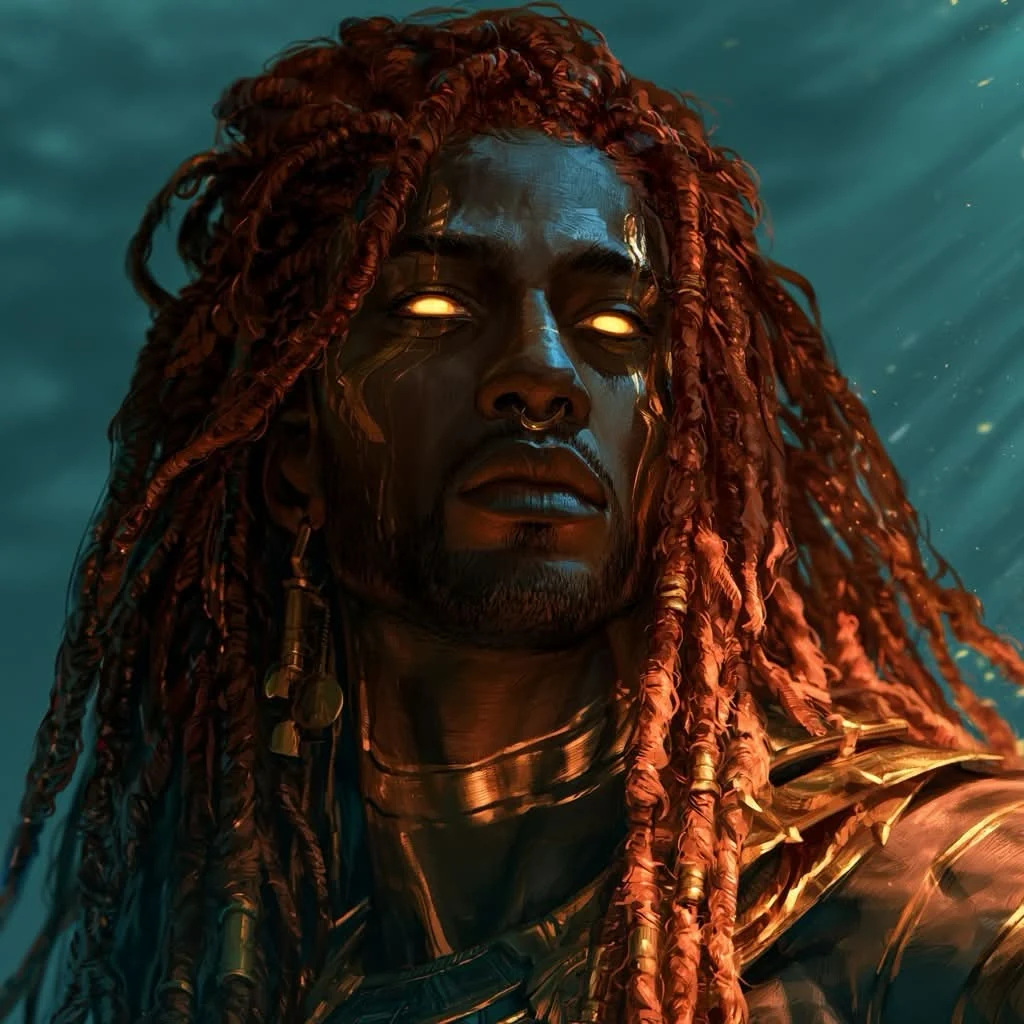
The Altaghyir are the rarest of the three. They are long-lived (by centuries), possess considerable physical strength, and communicate through a much more developed form of telepathy. Their abilities vary between families and lineages, and some possess gifts that have no equivalent among either humans or Qawm. To the other peoples, these abilities can appear supernatural. To Altaghyir, they are ordinary aspects of their biology.
One of the things I want to explore in particular is how profoundly their biology influences their culture.
The Altaghyir share several behavioral and social characteristics with killer whales, particularly in their family structures and social politic. I envision their family groups as closely bonded, multigenerational communities in which maternal relationships hold enormous importance. Children remain connected to their mothers and extended families well into adulthood, and the oldest members can carry knowledge accumulated over centuries.
Like killer whales, different families and populations develop their own traditions, methods of communication, and ways of interacting with the world. Knowledge can pass between generations without being written down, and a family’s accumulated experience becomes one of its most valuable possessions.
Their social attachments are powerful, but so are their territorial instincts, rivalries, and capacity for violence. They can be extraordinarily protective of their own while having little regard for those outside their family or social group. These characteristics affect everything from courtship and childrearing to inheritance, warfare, and political alliances.
And because they live for centuries, these relationships operate on a different timescale. A disagreement between two families might remain relevant long after several generations of humans have lived and died. An inheritance dispute might involve people who personally remember the original agreement. A family’s oldest living members may have witnessed events that other societies know only through historical accounts.
Over time, these extended family groups become the foundations of larger political structures. Families establish Houses, Houses form alliances, and entire territories come under the authority of particular lineages.
02Authority by Way of Time
Another aspect I find interesting is that the Altaghyir never necessarily intended to become the world’s ruling class.
Their authority emerged gradually through the considerable advantage of time. Humans and Qawm establish institutions, accumulate resources, develop relationships, and eventually die. Their children inherit what they can, often changing or abandoning what came before. The Altaghyir, meanwhile, remain.
An individual might outlive several generations of human rulers, witness the creation and dissolution of governments, or maintain relationships with families whose original founders have been dead for centuries. They can remember the circumstances of agreements that everyone else knows only through records. Their personal wealth and influence accumulate over lifetimes that would encompass several human generations.
Eventually, entire communities come to regard certain Altaghyir as permanent fixtures of their political and social lives. Their continued presence provides stability, particularly during periods of upheaval. What begins as familiarity, reliance, or a longstanding relationship can gradually develop into institutional authority.
The political system that eventually emerges is therefore an accumulation of thousands of years of relationships, obligations, and inherited arrangements. Some Altaghyir families take an active interest in governance, while others prefer to leave the management of their territories to Qawm administrators or human institutions. Their involvement varies considerably, as do their attitudes toward the responsibilities they have inherited.
03A Different History
This is where the familiar history of Earth begins to change considerably. The Altaghyir became the dominant political and economic class, maintaining authority through longevity, inherited resources, social relationships, and abilities that the other peoples could not easily challenge. The Qawm occupied an influential but subordinate position, frequently serving as administrators, scholars, diplomats, and intermediaries. Humans make up the majority of the population, with their communities governed through varying combinations of local institutions and the larger system of Altaghyir authority.
The resulting social hierarchy is biological, political, and economic. An individual’s species, family, and lineage influence the opportunities available to them, sometimes more than personal wealth or accomplishment.
I want to examine how this arrangement develops over thousands of years, and how it changes the history we recognize.
The regions we know as Africa, Europe, Asia, and the Americas still exist, but their political and cultural histories have followed different courses. European expansion does not become the organizing force of global history in the same way. African and Indigenous societies retain different centers of influence, and the colonial relationships that shaped our modern world develop under very different circumstances.
Religions spread differently. Empires rise and fall under different conditions. The Atlantic slave trade, racial hierarchies, and the borders of modern nations cannot develop exactly as they did in our history.
I also want to give considerable attention to the cultural geography of this Earth. The development of societies across Africa, Asia, the Americas, and Europe reflects different population distributions and histories of Altaghyir and Qawm influence. Local languages, religions, customs, and political institutions have survived or changed under circumstances quite different from our own.
That does not mean these societies are free of exploitation, prejudice, or oppression. Their inequalities have developed around different biological and historical circumstances. A society governed by people who consider themselves responsible for the welfare of others can still deny those people political independence. A family that has protected a territory for centuries can also believe it has an unquestionable right to possess it.
At the same time, I have no interest in presenting this alternative history as an ideal society. People are still capable of cruelty, discrimination, exploitation, and remarkable selfishness. The prejudices that develop are shaped by different circumstances, but their consequences can be just as serious for those who experience them.
I am particularly interested in the contradictions that emerge when authority is understood as both a privilege and a responsibility, and when those who hold it can remain alive long enough to resist changes that other generations consider necessary.
I think this provides an interesting basis for examining political and social change. What happens when a society begins to question arrangements established centuries earlier, while the people who originally made those arrangements are still alive? How does a government negotiate with an individual whose authority predates the government itself? And how do people who have spent centuries maintaining a particular understanding of their responsibilities respond when those under their care no longer want that arrangement?
These questions become more complicated when the people involved genuinely believe they are acting in everyone’s best interests. An Altaghyir might regard the protection of a particular community as a responsibility inherited from their ancestors. The people living in that community might appreciate that protection while also wanting greater authority over their own affairs. Neither position requires the other to be entirely unreasonable.
I want those disagreements to exist alongside the more ordinary concerns of everyday life. A Qawm administrator might spend decades navigating the expectations of an Altaghyir household while trying to establish an independent career. A human family might depend on an arrangement negotiated by an ancestor they know very little about. An Altaghyir household might struggle over an inheritance, a marriage, or the responsibilities owed to relatives who have lived together for centuries.
These are the kinds of circumstances that interest me because they allow the world’s larger history to influence individual lives without requiring every story to concern a war, a political revolution, or a struggle for control.
The modern setting retains many familiar aspects of daily life. People work, study, marry, raise families, argue about politics, and struggle with money. There are cities, businesses, universities, governments, and social movements. Yet beneath these recognizable institutions is a much older order of families and obligations that continue to influence who holds power and how it is exercised.
I want the magical realism to exist naturally within the environment to the point that it becomes almost mundane. Telepathy, inherited abilities, mental influence, and unusual lifespans are accepted parts of everyday existence. Their consequences are social and personal as much as physical.
My approach to the magical elements follows a similar principle. I want to establish what these abilities mean for ordinary people and the institutions they build. Telepathy changes how people communicate, but it also affects privacy, education, law, and interpersonal relationships. Longevity changes inheritance, retirement, marriage, and political succession.
These capabilities have existed throughout recorded history, so the people living with them have developed customs, expectations, and institutions around their use. I want to explore those arrangements as ordinary parts of society, including the ways they succeed, the ways they fail, and the people who challenge them.
I also want to explore how these differences affect relationships between the three peoples themselves. Their societies have developed alongside one another for so long that their histories are inseparable, even where their communities remain socially divided. Friendships, marriages, political alliances, and intimate relationships across these boundaries exist, although they are not always accepted. Questions of lineage, inheritance, reproduction, and social standing make some of these relationships considerably more complicated than others.
There are also people who do not fit comfortably into any of the three established categories. The Isnan, for example, are the rare children of Altaghyir and human unions. Their existence complicates assumptions about biological compatibility and the inheritance of abilities. They may possess some of their Altaghyir parent’s gifts, but they do not enjoy the same longevity or social recognition. Their place in society raises questions about belonging, legitimacy, and what it means to inherit a family identity that the family itself may refuse to acknowledge.
There is also a great deal of room for cultural variation. The Altaghyir are not a single, culturally uniform population. Their lineages have developed across different continents and historical periods, and their family structures, traditions, abilities, and expectations differ accordingly. The same is true of the Qawm and humans. Shared biology does not mean shared politics, religious beliefs, or social practices.
I would like this distinction to remain important throughout the manuscript. There should be enough variation within each population so that individuals can disagree with the traditions of their own communities without necessarily rejecting their identities. Families can be affectionate and controlling, generous and territorial, remarkably progressive in some respects and resistant to change in others.
As for the stories themselves, I envision The Altaghyir as the beginning of a much larger body of work. I haven’t decided whether the title will belong to the first novel or the series as a whole, but I want the setting to support several interconnected stories over time.
I am particularly drawn to stories about relationships, family obligations, political disagreements, and the decisions people make when their private desires conflict with the expectations of their communities. There is room for romance, domestic life, social ambition, generational conflict, and the occasional violence that accompanies disputes between people with considerable resources and very long memories.
The historical material gives me a basis for their cultures and institutions, but I expect much of the world to become clearer through the stories themselves. I am interested in the small details that follow from larger assumptions.
I don’t expect to answer all these questions in a single book, and I don’t particularly want to. Part of the appeal of developing this setting is the opportunity to return to it through different communities, historical periods, and perspectives, allowing the world to become more familiar as its people go about their lives.
04Why I Want to Write This
I want to tell stories centered on Black and brown queer people within this setting. I want them to occupy every part of society, particularly positions of authority, wealth, and cultural agency that have so often been denied to them in the histories we know. I am interested in what love, family, sexuality, and personal autonomy look like in societies whose assumptions about gender, marriage, reproduction, and inheritance have developed along different lines. Queer relationships are part of these cultures’ histories, rather than something that existed, was hidden or rewritten, and only re-emerged in the modern era.
In particular, I want to spend time developing Black and Indigenous cultures as established centers of intellectual, economic, and political life. I am interested in exploring societies where European colonialism and the racial hierarchies that followed it did not establish the foundations of the modern global order. I want to consider how that changes everything from international relations to beauty standards, education, religion, and the way different communities understand their own histories. I want Black and brown queer characters to experience the full range of these circumstances. Their identities will influence their lives, as identities always do, but I don’t want their stories to be restricted to experiences of marginalization or the constraints of our current realities.
I see this project as part of my interest in Afro-futurism and the possibility of Black futures that are not defined by the historical conditions of our own world. I want to imagine Black, brown, and Indigenous peoples whose cultures, institutions, and relationships have developed under different circumstances, and whose histories are not organized around European expansion or colonial domination. I want to explore what those differences would mean for the everyday lives of Black and brown people, particularly queer people, without expecting their societies to be perfect or their experiences to be uniformly positive. My aspiration is to create worlds beyond the one we currently live in, where Black people have the freedom to exist as complete, complicated individuals, with histories, futures, and possibilities that belong to them.
Something that has always bothered me about speculative fiction is how often worlds that place non-white or otherwise marginalized people in positions of authority reproduce the same paternalistic assumptions found in more conventional settings. Once these people are no longer marginalized, there seems to be an expectation that they must become the oppressors themselves, or that their authority must come with some superior wisdom that entitles them to manage everyone else. I dislike both conventions, along with the related tendency to make historically marginalized peoples responsible for either correcting humanity’s failures or reproducing them with the roles reversed. Within this work, I want to do my best to avoid these assumptions, particularly the idea that power must inevitably produce the same social relationships regardless of who possesses it.
Literacy, Literature, and Who Gets the Credit
One example of this is how I approach literacy, literature, and scientific development. Despite their extraordinary biological capabilities and longevity, the Altaghyir and Qawm made very little meaningful contribution to the original development of written languages and literacy. In fact, even in the modern setting (circa 2030s), many older Altaghyir (e.g., individuals aged 350+) remain unable to read or write in any language. This is because they never needed to, and for most Altaghyir learning to speak multiple languages is more than enough hassle. Their telepathic abilities, long memories, Qawm subordinates, and established methods of passing knowledge between generations allowed them to function without written communication. Some savvy ones might naturally choose to learn at some point, but even they may have only learned the one language or script, centuries ago.
Naturally, as written languages and literacy became increasingly important to the societies around them, the Altaghyir found ways to benefit from these developments. Often this meant requiring the Qawm under their authority to learn to read and write on their behalf. Why spend centuries learning something yourself when you can make someone else do it for you? There is something rather amusing about the possibility of an extraordinarily powerful, centuries-old Altaghyir who can influence the thoughts of everyone in a room but cannot read the document sitting directly in front of them.
I want these contradictions to exist because the Altaghyir are neither intellectually superior in every respect nor uniquely responsible for the development of civilization. Their considerable abilities do not make them a gifted alien race that arrived to enlighten humanity or guide it toward some higher form of existence. At their best, they have been effective peacekeepers, providing stability and continuity to communities that might otherwise have experienced considerable upheaval. At their worst, their influence, longevity, and capacity for coercion have allowed them to remain involved in circumstances where their continued presence was neither wanted nor beneficial.
The introduction of two additional humanoid peoples also does not diminish the enormous contributions of humanity to the development of civilization, particularly those originating from Black, brown, Indigenous, and diasporic communities. Human achievements in language, literature, mathematics, science, medicine, philosophy, architecture, and the arts remain fundamentally human achievements. I have no interest in attributing those accomplishments to an older or more powerful species simply because that species happens to exist in the setting.
This is particularly important to me because I want to imagine a world in which Black and brown peoples are recognized for the civilizations, knowledge, and cultural traditions they developed themselves. Their achievements should not need supernatural explanations, outside intervention, or the approval of a more powerful population to be considered extraordinary. I want the presence of the Altaghyir and Qawm to complicate humanity’s history while preserving humanity’s own ingenuity, accomplishments, and capacity to determine its future.
For me, that is part of what makes this alternative Earth worth exploring. I can change its evolutionary history, its political arrangements, and the distribution of power without surrendering the intellectual and cultural contributions of the people whose stories I most want to tell. I can imagine Black futures that extend beyond our current circumstances without requiring Black and brown people to become either idealized caretakers or the next generation of oppressors.